
JETT TURBO from Hot Octopuss review
 Review of JETT TURBO from Hot Octopuss
by Shamus MacDuff
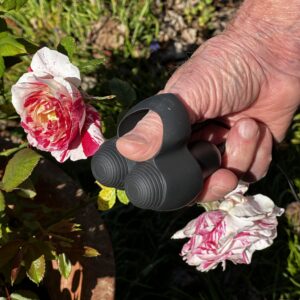
JETT TURBO is an odd-looking sex toy. It consists of a flat “plate” attached to a long cord that bifurcates into two plugs. The plugs insert into two bullet-like motors that share a stretchy sleeve-like “crest.” The crest is “the room where it happens.”
“Wait a minute,” you say. “Isn’t there already a penis toy named JETT from Hot Octopuss?” Yes, there is. But like many sex toys, as technology changes improved versions that add desirable features are developed. Such is the situation with the new JETT TURBO.
The word turbo connotes speed and high performance. Both apply to this wonderful new sex toy. JETT TURBO is more powerful than its predecessor while retaining all its desirable features. It is meant primarily for solo play, but it allows for exciting partner play as well.
Flaccid or erect, insert your penis (*see photo note) into the flexible sleeve and align your frenulum above the twin motors.

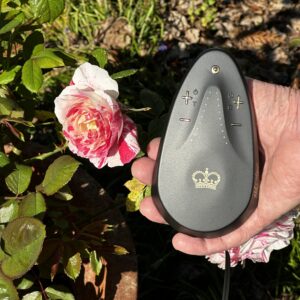
Next, using the control plate, play with different intensities from the treble and bass motors to find your personal optimum. You can then select from eight different patterns to yield a wide variety of stimulation.
If you’re partnered, your lover may discover—as mine did!—that a tongue on the protruding penis head takes pre-orgasmic pleasure to a sublime level.
Pioneering the development of sex toys designed especially for penis owners, Hot Octopuss introduced the Pulse “guybrator” in 2013. A few years later, they added the dual-engine JETT in 2019. The original JETT brought us their innovative patented treble and bass technology.
Now 7 years later the JETT TURBO contains many new, improved features:
- Lithium battery charges via a USB cable instead of four replaceable AA batteries.
- Convenient 29-inch retractable cord versus an 18 inch non-retractable one.
- Considerably lighter than the original JETT, weighing just over half a pound total (271 grams).
- Power pack is smaller, flatter, much more attractive, and contains colored lights that indicate the different intensity levels.
- Detachable bullet motors are waterproof, facilitating cleaning. (The power pack is not waterproof.)
- Made of body safe silicone.
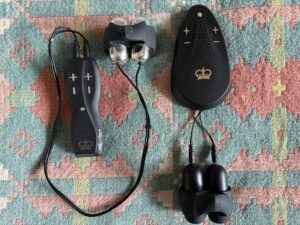
Original JETT vs Turbo
I had continued to enjoy the original JETT in spite of the periodic inconvenience of purchasing new batteries. But now that I’ve experienced the new refined model I see why Hot Octopuss has invested in JETT TURBO. The performance and convenience are superb, as you’ll see when you give it a go!

Thank you, Hot Octopuss, for sending me the JETT TURBO in return for an honest review! Learn about the other splendid toys for penis or vulva at Hot Octopuss.com.
—Shamus MacDuff, age 82, was oblivious to the delights of sex toys for penises until age 73. He’s been making up for lost time! Read his other posts at https://joanprice.com/tag/shamus-macduff.
*Photo note: No penises were harmed in these photos. Realistic flaccid penis is the Sailor Soft Pack from Good Vibrations!
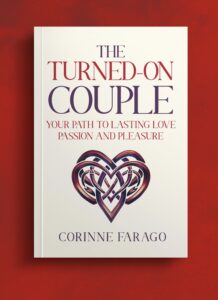
The Turned-On Couple by Corinne Farago

The Turned-On Couple
by Corinne Farago
Reviewed by Mac Marshall
Corinne Farago
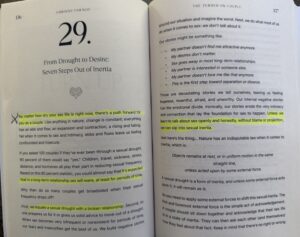
“No matter how dry your sex life is right now, there’s a path forward for you as a couple.” (p.136)
Are you in a long-term marriage or partner relationship? Do you two bicker over small matters and often feel irritated with one another? Has the quality and frequency of your sex life fallen into a rut? If so, Corinne Farago’s book The Turned-On Couple may be just what you need.

In this book, Farago distills her coaching experiences into a self-help guidebook for relationship rejuvenation. She argues that we all crave relationship intimacy, but a couple’s level of intimacy may weaken over time. Honest communication can revive that intimacy. Intimacy in turn builds trust. Trust lets us be vulnerable. Vulnerability allows us to gain self-acceptance and discover our authentic sexual selves. That then frees us to communicate with our partner about what works for us sexually, and why.
Farago seeks to jolt those of us in long-term relationships who may have become “comfortably numb” to our partner. Her goal as a sex coach is to help couples manage problems she finds commonplace in long-term relationships. These include conflict mismanagement, communication difficulties, desire discrepancies, and lackluster sex lives.
The Turned-On Couple is divided into 65 brief chapters, each focused on a specific issue. These are sorted into three major sections, reminiscent of Timothy Leary’s famous counterculture-era phrase, “Turn on, tune in, drop out.” However, Farago wants us just to turn on, not to drop out. The book’s sections are:
- Tune In (28 chapters): “You’ll learn about the essential skills of building a secure and loving foundation for your intimacy to thrive. Use these lessons to guide you and your partner in conversation, and discover how to build new habits in love that support your passion.”
- Turn Up (16 chapters): “We look at the often-mysterious world of desire, how to turn up your own desires, and how to confidently express those desires to your partner….Through practical guidance and reflective exercises, let’s explore how to turn up desire with authenticity, empathy, and vulnerability.”
- Turn On (21 chapters): “We embark on a voyage of exploration, shedding light on the secrets to cultivating a deeply satisfying and fulfilling sexual connection. From communication and vulnerability to pleasure and new adventures, let’s look at the essential elements that pave the way to becoming a Turned-On Couple.”
These chapters range from 2 to 6 pages. Farago has designed the book so that you can read it all the way through from front to back, or you can select particular chapters of interest. Every chapter contains ideas for solving particular problems. These examples convey the flavor of her suggestions:
“When couples learn how to talk about sex from a place of curiosity and playfulness, they realize that sex talk can be fun. Talk about what you like and want more of. Talk about sex after you have sex, and share your highlights. If sex has become boring, you know it’s time to start growing again.” (p.22)
- “In order to maintain mystery in a long-term relationship, you want an ongoing balance of attachment and independence….Find ways of taking space and doing your own thing. See friends, exercise, or start a new sport or hobby that engages you. Differentiate yourself from your partner in healthy ways. Romantic attachment is important to build trust and safety, but creating space from your partner is the necessary ingredient to building desire.” (p.86)
- “In long-term relationships, consent means more than just asking for sex; it’s asking about what kind of sex we want….It’s a conversation about needs and desires. It’s checking in with your partner and ensuring that you both have an opportunity to express an enthusiastic “yes” to what’s being offered, whether that’s a foot massage, intercourse, or something new on the erotic menu.” (p.274)
I have a mild criticism: what is meant by a “long-term relationship” is never specified. Five years? Fifteen years? Fifty years? We’re left to intuit this.
Although not written specifically for seniors, Farago’s focus on long-term relationships makes this book relevant to the many seniors who live in decades-long marriages. Others of us—widowed or divorced—develop what may become lengthy new relationships outside of marriage in our later years. In both circumstances, The Turned-On Couple offers much helpful advice to older adults.
Visit Corinne Farago’s website. Order The Turned-On Couple from your local bookseller, or Bookshop.org (which benefits indie booksellers), or Amazon.

Mac Marshall, PhD is a retired anthropology professor, researcher, and author who is delighted to explore sexuality studies at this time of his life.
Arcwave Zing Stroker Review

Arcwave Zing Stroker Review
by Shamus MacDuff

What guy wouldn’t enjoy a fling with Arcwave Zing, an innovative self-pleasuring stroker vibrator for the penis in your life! Zing boasts a unique design: it’s a 4-1/4” long, adjustable width “sleeve” masturbator that is open along its length. Stretch it apart to reveal a ribbed interior. Add water-based lube to the interior and to your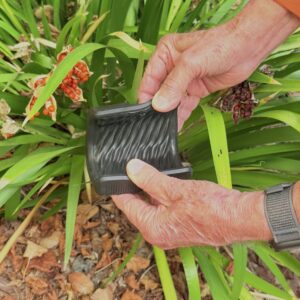 penis. Insert penis — flaccid or erect — then squeeze the sleeve snugly. Wrap your hand around it, turn on the vibrations, and enjoy!
The word zing means energy, enthusiasm, liveliness. Arcwave Zing delivers all of these with 10 different patterns and 10 intensity levels. It’s fun to experiment with different energy combinations to find those that work best for you. You’ll get so enthusiastic that you might like to dance during your Zing fling. If so, I suggest you “do the twist.” Twisting and rotating the toy around your penis adds lively new sensations to the in-and-out strokes.

Have you ever wrapped foam insulation sleeves around exposed water pipes to protect them from freezing? My first view of Zing brought pipe insulation immediately to mind. The difference is that wrapping with Zing will stimulate rather than insulate your “pipe.”
Arcwave Zing combines some features of two other excellent penis toys: Pulse by Hot Octopuss and Body Kisses by Gender X. Like the Pulse, it works well whether or not your penis is erect, and it leads quickly to  orgasm. Like Body Kisses, it can attach to your penis hands-free, hanging down to tickle your scrotum and encouraging nipple play.
As with both of those toys, Zing’s controls are easy to use.
Other perks:

- Fully waterproof.
- Add the stretchy band (included) to secure it for a hands-free experience.
- Made of body safe silicone.
- Charges via USB.
- Arrives in an attractive box with a handsome cloth case for storage.
Arcwave Zing is an excellent addition to any penis owner’s toy collection. You’ll discover that your thing will spring with a Zing!

Arcwave Zing available from Betty’s Toy Box

Don’t forget: 10% off with coupon code JOAN10
—Shamus MacDuff, age 82, was oblivious to the delights of sex toys for penises until age 73. He’s been making up for lost time! Read his other posts at https://joanprice.com/tag/shamus-macduff.
Melt 2 from We-Vibe: Puff the Magic!


I have a new favorite sex toy, and its name is Melt 2, the new Pleasure Air Clitoral Stimulator from We-Vibe, sold by Betty’s Toy Box. Whether you’re already a connoisseur of “pleasure air” or “air puff” technology or wondering what it’s all about, I predict that the Melt 2 will thrill you. It does me!
How does it work?
First apply a good water-based lubricant. Hold the Melt 2 and press the opening over your clitoris so it surrounds your clitoral nub (glans clitoris). Turn it on with the “+” button and feel it deliver air pulses directly to your clitoris that feel like gentle sucking or nibbling. The sensation is tough to describe, but utter pleasure to experience.
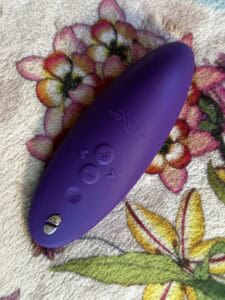 Rev up to your choice of 12 intensity levels: the “+” button increases power and sensation; the “-” button lowers it. Explore the 6 patterns, controlled by the raised “<” and “>” on the left and right.
After your orgasm(s), power it off by holding the “-” button until it stops.
I can’t guarantee you easy orgasms from any product. What we need and how we need it is highly individual — see “How to Choose a Vibrator.” But I’ll say that from my experience and other reviewers, the intensity and technology of Melt 2 deliver strong, dependable, even fast results.
Full disclosure here: The lovely folks at Betty’s Toy Box sent me the Melt 2 in May when I was in extreme pain from April car crash injuries. I honestly didn’t know if my body was capable of feeling pleasure. Was I surprised when the Melt 2 delivered! I’m telling you this because it might have affected my evaluation of this joy-giving toy — or maybe the Melt 2 is just that good! Let me know what you think in the comments once you’ve tried it.
What if more than my clitoris wants stimulation?
If you enjoy vaginal penetration along with direct clitoral stimulation, you’ve probably found that many clitoral toys cover too much space, making it difficult to insert your penetrator of choice, whether it’s fingers, an invited penis, or a dildo. Both the original Melt and the Melt 2 are shaped for minimal disruption to vaginal access. In fact, the Melt 2 is marketed as a couple’s toy which can be used during intercourse. True, but let’s acknowledge that there are many other ways to involve a partner in your journey to orgasm, not just intercourse. The Melt 2 takes care of your clitoris while your partner can stimulate your other pleasure receptors.
No partner? No problem. Melt 2 is terrific solo.
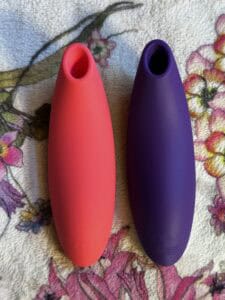
How does it compare with the original Melt?
The original Melt (reviewed in 2019) is identical in shape, size, and intensity levels. The original does not have the 6 patterns or the Smart Silence feature. If you already own the original and you don’t care about the extra features, no need to upgrade. Betty’s Toy Box is selling both products at the same price, as of this writing, so if you don’t own either, I’d go for the new one.
What’s “Smart Silence”?
This feature stops the product from working unless it’s in contact with skin. You press the button to turn it on, and although the light flashes, nothing happens. Press it to your skin, and it starts. Take it away from your skin, it turns off. Some people find that handy (easy stop if you’re interrupted, or a way to tease your body). Others find it annoying. If you’re in the latter camp, you can turn off the Smart Silence feature by double-clicking the wavy button.
What else?
- Ergonomic, easy to hold, no vibrations to the wrist.
- Waterproof.
- Can be controlled remotely via an app.
- Made of body safe silicone – phthalate-free, latex-free, non-porous.
- Charges via USB with a magnetic connector.
- User manual is unusually user-friendly!
How lucky we are to live in a time when sex toy innovation makes it possible for you to find the perfect toys for your personal body needs and preferences. Though I would never say that any one sex toy is “best” for everybody — or every body — for me, as a 81-year-old sexual pleasure seeker, We-Vibe’s Melt 2 is as perfect as a sex toy can be!
10% off with coupon code JOAN10